Breaking Free from the Fork: Meta's Journey to Upstream WebRTC Across 50+ Applications
Introduction: The Forking Trap at Scale
At Meta, real-time communication (RTC) is the backbone of services used by billions—from Messenger and Instagram video calls to low-latency cloud gaming and VR casting on Meta Quest. For years, Meta relied on a heavily customized fork of the open-source WebRTC library to meet the extreme performance demands of these applications. But maintaining a permanent fork of a rapidly evolving upstream project is a well-known industry pitfall. What starts as a few targeted optimizations and bug fixes can quickly snowball into a divergent codebase that drifts further from community updates, making integration of new features, security patches, and performance improvements increasingly difficult and costly. Meta recently completed a multiyear migration to break this cycle, moving over 50 use cases from an internal fork to a modular architecture built on the latest upstream WebRTC. This article explains how they engineered a solution to escape the “forking trap,” enabling continuous upgrades and safe A/B testing at scale.
The Challenge: Monorepo Constraints and Linker Collisions
Upgrading a foundational library like WebRTC while serving billions of users is inherently risky. A one-time rollout could introduce regressions across a vast array of devices and network conditions, with no easy rollback. Meta needed the ability to A/B test the new version alongside the legacy one within the same application, dynamically switching users between them to verify stability and performance.
However, Meta’s codebase is a monorepo, where static linking is the norm due to build graph and binary size constraints. Statically linking two versions of WebRTC violates the C++ One Definition Rule (ODR), causing thousands of symbol collisions. The team had to find a way to make two versions of the same library coexist in the same address space without conflicts.
Building a Dual-Stack Architecture for Safe A/B Testing
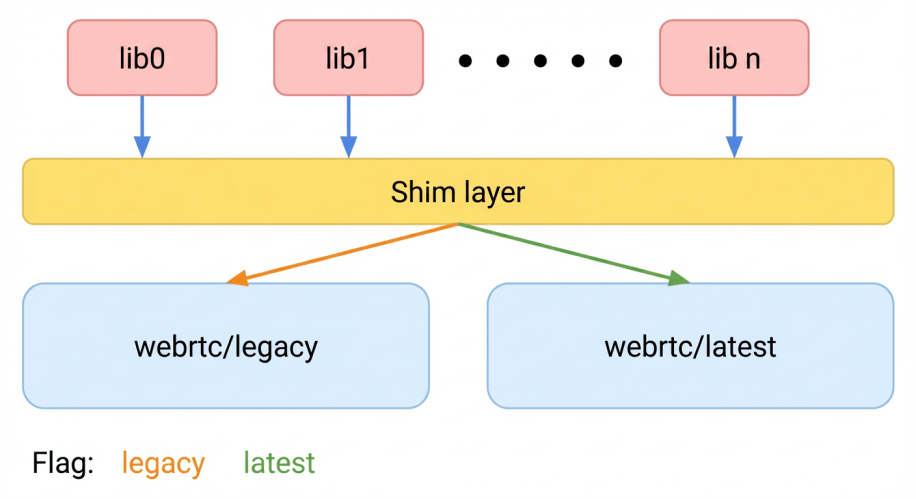
To solve the ODR issue, Meta developed a dual-stack architecture that allowed both the legacy fork and the new upstream-based version to be compiled and linked within a single library binary. This was achieved through a combination of namespace isolation, careful build system customization, and component-level abstraction. The architecture facilitated safe A/B testing across all 50+ use cases, enabling engineers to gradually migrate each service while collecting real-world telemetry on performance, binary size, and security.
A/B Testing Workflow
Each new upstream release is first tested against the dual-stack framework in a controlled environment. Only after passing A/B validation—demonstrating no regressions in key metrics—is it rolled out broadly. This continuous upgrade cycle ensures Meta benefits from the latest WebRTC improvements without risking user experience.
Results: Performance, Binary Size, and Security Gains
The migration delivered measurable improvements. By aligning with upstream WebRTC, Meta reduced its maintenance burden and gained access to community-driven optimizations. Binary sizes shrank due to better modularization, and security vulnerabilities were patched more rapidly. The dual-stack approach itself became a best practice: Meta continues to use it to A/B test each new upstream WebRTC release before full deployment, effectively escaping the fork trap for good.
Conclusion: Continuous Upgrades as a Strategic Advantage
Meta’s journey demonstrates that large-scale WebRTC consumers don’t have to choose between customization and staying current. By investing in a dual-stack architecture and a rigorous A/B testing pipeline, they turned a potential technical debt nightmare into a sustainable, low-risk upgrade process. Other organizations facing similar scaling challenges can learn from this approach—particularly the value of continuous A/B testing and namespace isolation when managing large open-source forks.