Meta's Enhanced Encryption: A Deeper Look into Backup Security
Protecting private conversations is a top priority for Meta, especially as WhatsApp and Messenger users increasingly rely on cloud backups. To fortify end-to-end encrypted backups, Meta has developed a sophisticated system centered on a Hardware Security Module (HSM) Backup Key Vault. This infrastructure ensures that recovery keys remain inaccessible to Meta, cloud providers, or any third party. Recent upgrades include over-the-air key distribution for Messenger and a commitment to publishing evidence of secure fleet deployments—further strengthening user trust.
The Foundation: HSM-Based Backup Key Vault
At the core of Meta's encrypted backup strategy is the HSM-based Backup Key Vault. This system allows users to protect their message history with a recovery code, which is stored inside tamper-resistant hardware security modules. These HSMs are designed to prevent unauthorized access, meaning not even Meta can retrieve the recovery code. Instead, the code is only accessible to the user via their device or passkey.
The vault is deployed as a geographically distributed fleet across multiple data centers, ensuring high availability and resilience. By using majority-consensus replication, the system can tolerate failures in individual locations while maintaining data integrity and accessibility. This design ensures that backups remain recoverable even in the event of regional outages.
Passkeys Simplify Encrypted Backups
Late last year, Meta introduced passkey support for end-to-end encrypted backups, making it easier for users to secure their data without relying on passwords. Passkeys provide a seamless, biometric-based authentication method that eliminates the need to remember complex recovery codes, while still maintaining strong encryption.
Over-the-Air Fleet Key Distribution
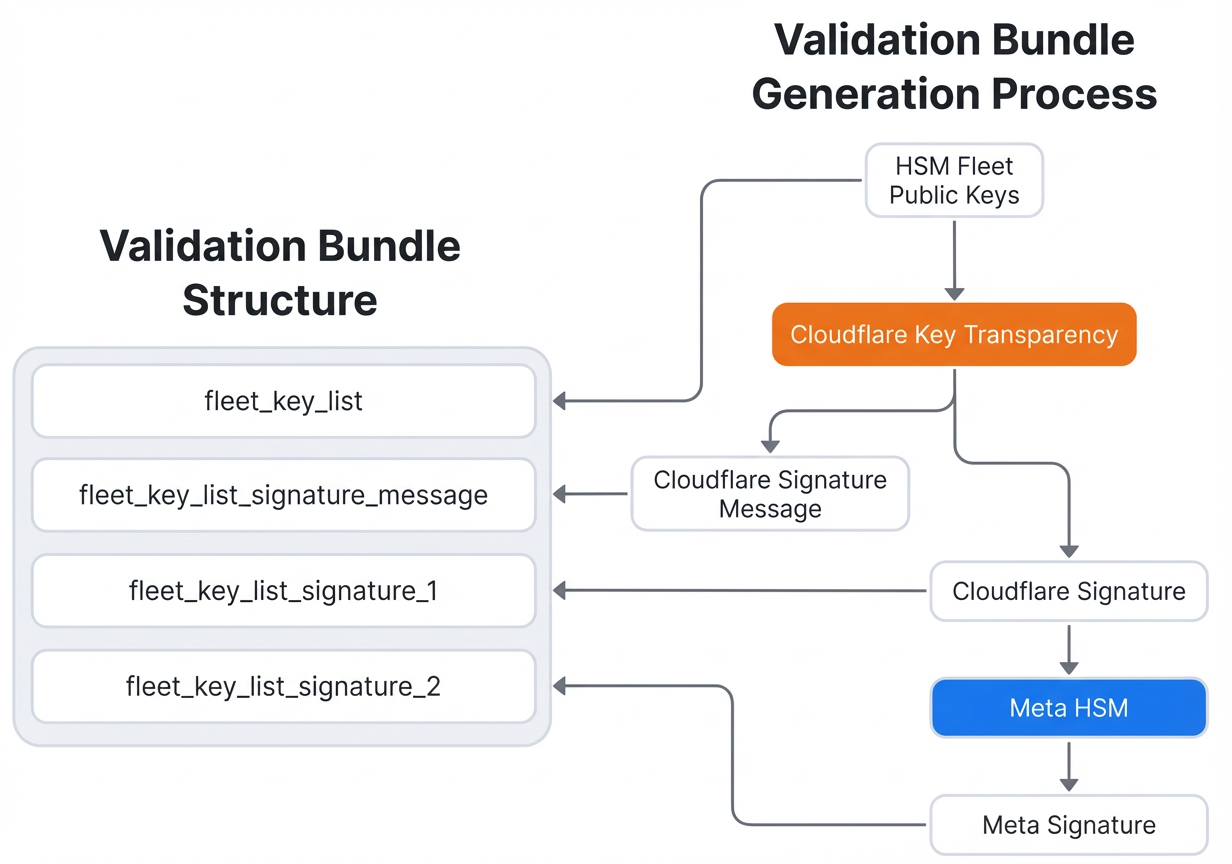
To ensure clients can verify the authenticity of HSM fleets, they validate the fleet's public keys before establishing a secure session. In WhatsApp, these keys are hardcoded into the app. However, for Messenger—where new fleets may need to be deployed without requiring an app update—Meta built a mechanism for over-the-air distribution of fleet public keys.
These keys are delivered as part of the HSM response in a validation bundle. The bundle is signed by Cloudflare and counter-signed by Meta, providing independent cryptographic proof of authenticity. Cloudflare also maintains an audit log of every validation bundle, adding an extra layer of transparency. The full validation protocol is detailed in Meta's whitepaper, Security of End-To-End Encrypted Backups.
Why Over-the-Air Distribution Matters
This approach allows Meta to deploy new HSM fleets for Messenger without forcing users to download app updates. It maintains security by leveraging external verification (Cloudflare) and internal signing (Meta), ensuring that only legitimate fleet keys are accepted. This flexibility is crucial for scaling the service and adapting to new security challenges.
Transparent Fleet Deployment
Transparency is essential to demonstrate that Meta's backup system operates as designed and that the company cannot access user encryption keys. Meta now publishes evidence of the secure deployment of each new HSM fleet directly on its engineering blog. While new fleet deployments are rare—typically every few years—this commitment allows any user to verify that each new fleet is deployed securely.
Verification Process
Users can follow the audit steps outlined in Meta's whitepaper to independently verify the integrity of a fleet deployment. By publishing cryptographic proofs and deployment logs, Meta empowers the community to confirm that the system remains free from unauthorized changes or backdoors. This level of transparency is rare among major tech platforms and reinforces Meta's leadership in encrypted backup security.
Looking Ahead
Meta continues to invest in the security of its encrypted backup infrastructure. With improvements like over-the-air key distribution and transparent deployment logs, the company is setting a higher standard for protecting user data at scale. As threats evolve, these measures ensure that WhatsApp and Messenger users can trust that their backed-up messages remain private.
For a complete technical specification of the HSM-based Backup Key Vault, read the full whitepaper: Security of End-To-End Encrypted Backups.